What is Overhead Gantry Crane and How Does It Work?
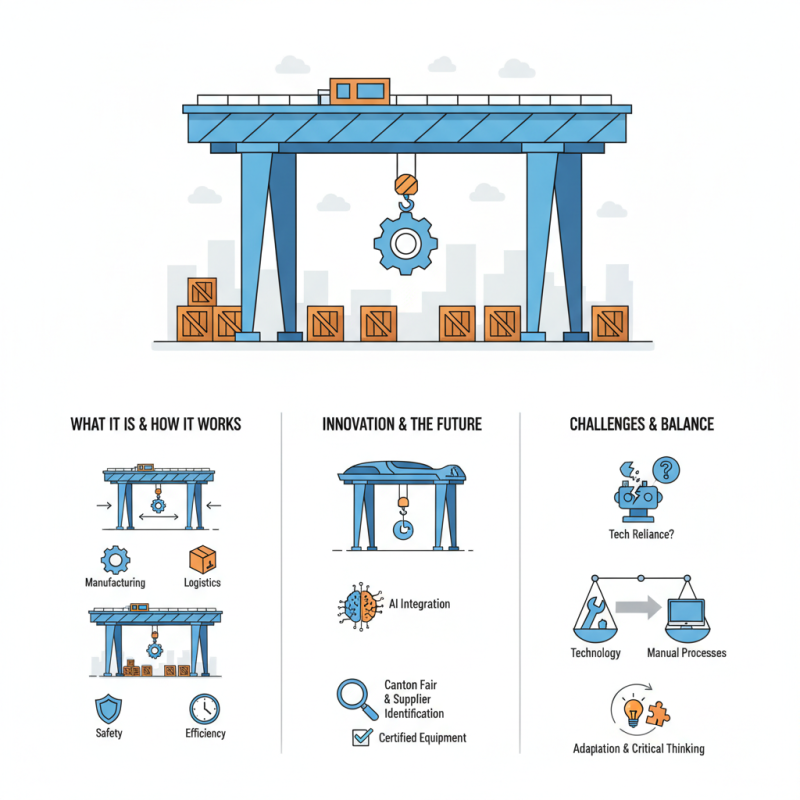
Overhead Gantry Cranes are essential equipment in the manufacturing and logistics sectors. They automate the movement of heavy materials, enhancing workplace safety and efficiency. These cranes operate using a bridge-like structure, allowing for precise material handling in various industries.
At the upcoming 139th Canton Fair, innovations in machinery, including Overhead Gantry Cranes, will be showcased. The integration of AI in exhibition navigation can help buyers identify suppliers with specific certifications. This matches well with the increased demand for reliable lifting equipment. Visitors will appreciate the efficiency AI offers during the event.
However, the reliance on technology raises questions. What happens if the AI fails? Companies should assess their manual processes too. Balancing technology with traditional methods is crucial. The evolution of tools like Overhead Gantry Cranes is exciting, but adaptation and critical thinking remain vital for progress.
What is an Overhead Gantry Crane? Definition and Overview
An overhead gantry crane is a vital tool in various industrial settings. It consists of a horizontal beam supported by two or more legs that move on tracks. This design enables the crane to lift heavy loads precisely. Industries like manufacturing and construction often rely on these cranes. According to the International Journal of Industrial Engineering, the crane market is projected to grow by 6.5% annually through 2027. This growth underscores their significance in enhancing operational efficiency.
Overhead gantry cranes can lift weights that exceed several tons. They are employed for transporting materials, assembly tasks, and storage needs. In a report by the Material Handling Industry of America, it was noted that nearly 30% of workplace accidents occur during material handling. This highlights a critical need for safety measures and training. Operators must understand the crane's limitations. Misuse can lead to accidents, causing downtime and financial losses.
These cranes demand regular maintenance for optimal performance. Inspections are crucial to ensure safety and reliability. Frequent wear on components can lead to failure. A proactive approach to maintenance can reduce risks. Data from the Occupational Safety and Health Administration points out that proper training reduces the likelihood of incidents by up to 40%. An investment in training and maintenance is essential for maximizing safety and efficiency in operations.
Key Components of Overhead Gantry Cranes Explained
Overhead gantry cranes are crucial in many industries. They assist in lifting and moving heavy loads safely. Understanding their key components helps in their effective operation.
The main structure is the bridge. This is where the load is supported. It usually spans a large area, allowing movement across the workspace. Another essential part is the hoist. This mechanism lifts and lowers the load. It can be electric or manual. The trolley, which carries the hoist, moves along the bridge. This provides excellent maneuverability and flexibility.
Tips: Regular inspections are vital. Check for any wear and tear on the cables and brakes. Unexpected failures can lead to accidents. Operators must be trained properly. Understanding weight limits is essential for safety. Load limits vary between different models.
The runway or rail is equally important. It supports the entire crane system. It is critical to ensure the runway is level and secure. Maintenance here can prevent many issues. Safety measures must be a priority. Always use the crane as intended to avoid mishaps.
Mechanics of Operation: How Overhead Gantry Cranes Lift and Move Loads
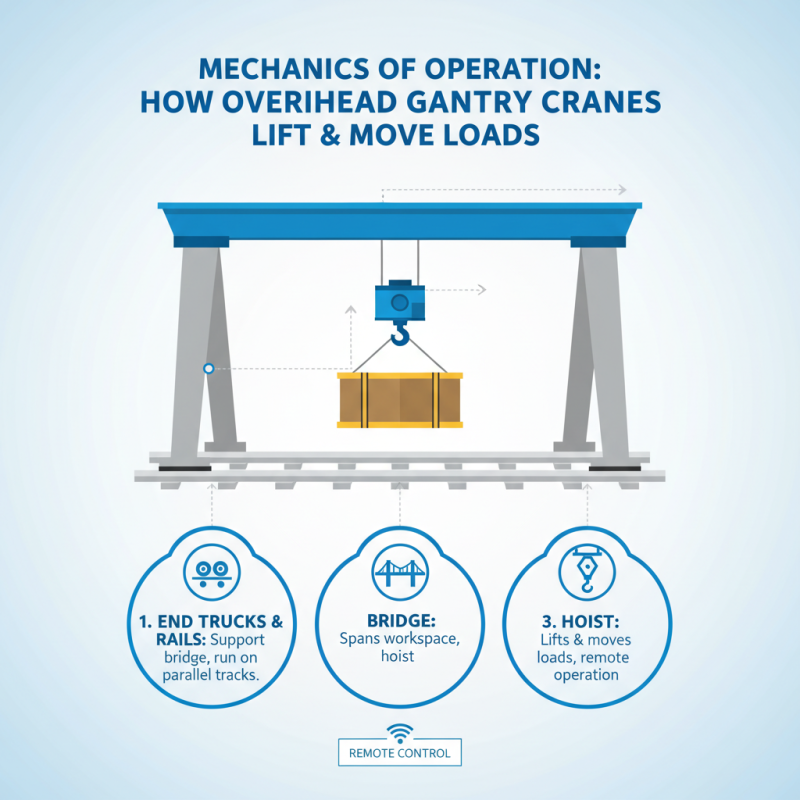
Overhead gantry cranes are essential tools in many industries. They consist of a bridge that spans a workspace. This bridge is supported by two end trucks, which run on parallel tracks. The crane lifts and moves loads using a hoist mechanism. The hoist is attached to the bridge and can be operated remotely.
The mechanics of operation involve several key components. When the operator activates the hoist, a motor powers the mechanism. This motor lifts the load through a system of pulleys and chains. The load can then be moved horizontally by traversing the bridge along the tracks. Adjustments may be needed for precise positioning. Sometimes, the load sways as it’s lifted. Operators must anticipate these movements to avoid accidents.
Maintaining balance during operation is crucial. If the load is too heavy, the crane may struggle. It is essential to know the weight limit. Regular checks on the crane’s components are also necessary. However, not all operators conduct these checks meticulously. Over time, neglect can lead to mechanical issues. Each part must work in harmony for safe operation.
Industries Utilizing Overhead Gantry Cranes: Applications and Benefits
Overhead gantry cranes are vital in various industries. They excel in heavy lifting tasks. The construction and manufacturing sectors heavily rely on them. According to a recent industry report, these cranes can reduce manual labor by up to 40%. This efficiency is attractive for businesses looking to streamline operations.
In the shipping and logistics industry, overhead gantry cranes play a critical role. They enhance loading and unloading processes in busy ports. Statistics show that cranes can improve turnaround times by up to 30%. However, safety remains a concern. Workers must be trained adequately to avoid accidents.
The automotive and aerospace industries also use these cranes. They assist in assembling large structures with precision. A study found that overhead cranes increase productivity by as much as 25%. Yet, maintenance costs can be a drawback. Regular checks are essential to ensure optimal performance. The need for balance between efficiency and cost remains crucial for many businesses.
What is Overhead Gantry Crane and How Does It Work?
| Application Area |
Key Benefits |
Typical Load Capacity |
Common Features |
| Manufacturing Facilities |
Increased efficiency and productivity |
Up to 100 tons |
Adjustable span, Electric hoists |
| Warehousing |
Space optimization |
Up to 50 tons |
Remote control, Safety features |
| Construction Sites |
Versatile lifting capabilities |
Up to 200 tons |
Portable designs, High lifting height |
| Shipyards |
Effective heavy load handling |
Up to 300 tons |
Customizable configurations, Durability |
| Metal Production |
Safety and reliability in operations |
Up to 100 tons |
Robust construction, High speed lifting |
Safety Standards and Regulations for Overhead Gantry Cranes in Use
Overhead gantry cranes are essential in various industries. However, safety is paramount when operating these heavy machines. Regulations and safety standards have evolved to ensure that cranes are used correctly. According to the Occupational Safety and Health Administration (OSHA), nearly 60% of crane-related incidents happen due to improper use or maintenance. This highlights the need for stringent safety protocols.
Guidelines specify that operators must receive adequate training. They should understand the loads they handle and the controls of the crane. According to a report by the Crane Inspection and Certification Bureau, only about 40% of crane operators have received formal training. This gap in training can lead to accidents, which is a significant concern. Properly functioning safety devices, like limit switches and emergency stop buttons, are critical. Yet, many cranes are found to be lacking in these features.
Regular inspections are mandated by the ASME B30.2 standard. Inspectors must check operational components and ensure compliance with the latest standards. Surprisingly, studies show that nearly 25% of cranes surveyed were not inspected regularly. This neglect can result in mechanical failures, compounding safety risks. Ensuring compliance and training is not just a box to tick; it’s essential for the safety of all personnel involved.