| Crane Configuration and Jib Types |
| Crane Type |
Telescopic straight-boom crane |
Rated capacity: approximately 1–25 t
Maximum reach: approximately 6–32 m |
Uses a hydraulic telescopic boom for direct lifting and placement. It is suitable for construction materials, utility work, roadside maintenance, and general cargo handling. |
Compare load charts at each boom length, hydraulic stability, boom-section construction, transport height, and available operator controls. |
| Crane Type |
Knuckle-boom or articulating crane |
Rated capacity: approximately 1–100 tonne-metres
Horizontal reach: approximately 4–25 m |
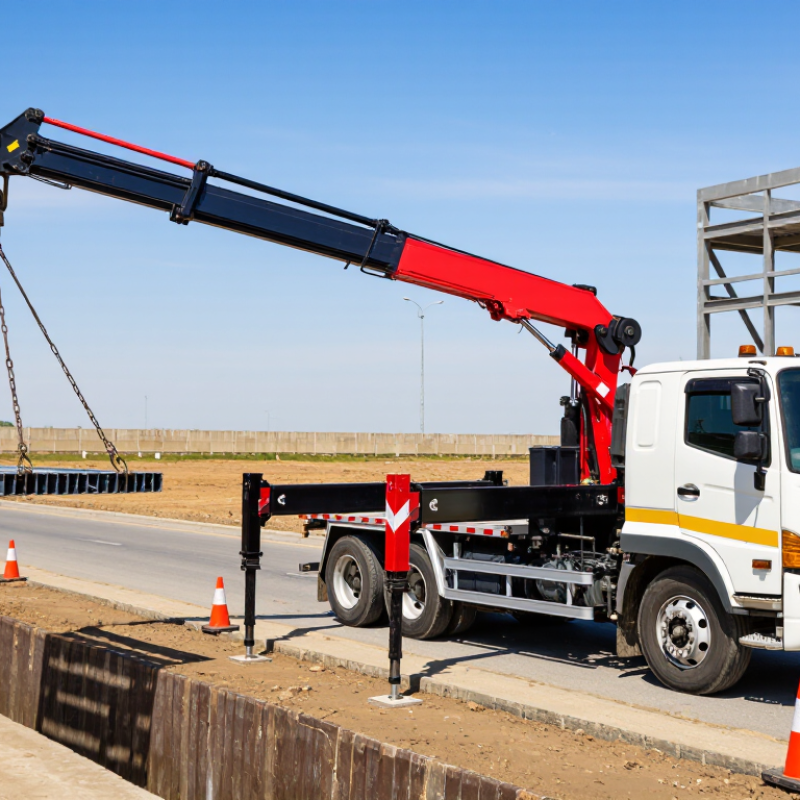
Folding boom geometry provides compact transport dimensions and good positioning around obstacles. Common applications include loading, delivery, recycling, forestry, and service operations. |
Check folding height, folded length, hose protection, articulation range, stability at side reach, and whether the load chart covers the required working position. |
| Crane Type |
Small service or maintenance crane |
Rated capacity: approximately 0.5–3 t
Typical reach: approximately 3–10 m |
Compact equipment mounted on light- or medium-duty trucks. It is designed for generators, pumps, tools, HVAC equipment, and routine maintenance loads. |
Verify truck payload after installation, available deck space, battery or PTO requirements, and the minimum working radius for the intended load. |
| Crane Type |
Heavy-duty truck crane |
Rated capacity: approximately 10–80 t
Typical maximum reach: approximately 10–40 m |
Mounted on heavy trucks for bridge work, infrastructure construction, industrial lifting, and large component handling. |
Assess axle loads, gross vehicle weight, counterweight requirements, outrigger footprint, road regulations, and site access limitations. |
| Crane Type |
Truck-mounted crane with auxiliary jib |
Additional jib reach: approximately 3–15 m
Capacity at jib tip: commonly 0.2–5 t |
An optional fixed or luffing jib improves height and reach when the main boom cannot access elevated or offset work areas. |
Confirm jib stowage method, permitted working angles, reduced load charts, installation weight, and the effect on overall vehicle height. |
| Capacity and Working Envelope |
| Rated Capacity |
Maximum rated lift |
Approximately 0.5–100 t, depending on crane class |
The maximum load is normally specified at a particular radius and configuration. It is not a universal capacity across the entire working envelope. |
Always use the manufacturer’s load chart. Include the weight of hooks, slings, spreader beams, buckets, and other lifting attachments. |
| Load Moment |
Capacity expressed in tonne-metres |
Approximately 5–300 tonne-metres for common truck-mounted units |
Load moment is calculated from load multiplied by horizontal radius. It helps compare cranes with different boom lengths and lifting capacities. |
Do not select equipment using load moment alone; verify actual capacity at the required radius, boom angle, outrigger position, and attachment configuration. |
| Working Radius |
Minimum to maximum horizontal reach |
Approximately 1.5–40 m |
Longer reach generally reduces lifting capacity. The usable radius depends on boom length, boom angle, jib configuration, and truck stability. |
Measure the distance from the crane rotation center to the farthest load point, including clearance from buildings, traffic, and overhead obstructions. |
| Vertical Height |
Maximum hook height |
Approximately 8–45 m above ground, depending on boom and jib configuration |
Hook height is affected by boom length, elevation angle, truck deck height, and the use of an auxiliary jib. |
Compare hook height under a loaded condition, not only the theoretical maximum at an unloaded boom angle. |
| Working Zones |
360-degree or limited-rotation operation |
Typical rotation: 360 degrees continuous or less than 360 degrees |
Continuous rotation supports flexible placement, while limited-rotation cranes may be lighter and more economical for simple loading tasks. |
Check capacity over the front, rear, and sides of the truck. Some load charts provide different ratings for each sector. |
| Truck Integration and Installation |
| Vehicle Class |
Light-duty truck |
Typical gross vehicle weight: 3.5–7.5 t |
Suitable for compact service cranes and light delivery work where road maneuverability and lower operating cost are priorities. |
Calculate remaining payload after adding the crane, subframe, hydraulic system, stabilizers, body, tools, and operators. |
| Vehicle Class |
Medium-duty truck |
Typical gross vehicle weight: 7.5–18 t |
Provides a balance between payload, reach, stability, and urban accessibility for construction and utility applications. |
Check axle distribution, deck length, suspension capacity, PTO compatibility, and local vehicle registration limits. |
| Vehicle Class |
Heavy-duty truck |
Typical gross vehicle weight: above 18 t |
Designed for high-capacity cranes, larger counterweights, longer booms, and demanding industrial or infrastructure work. |
Review road permits, bridge-weight restrictions, turning radius, site bearing capacity, and transport height with the crane installed. |
| Power System |
Hydraulic pump driven by PTO |
Typical hydraulic pressure: approximately 200–350 bar
Flow: approximately 20–150 L/min |
A power take-off and hydraulic pump provide lifting, slewing, boom extension, and stabilizer functions. |
Match pump flow and pressure to the crane valve system. Confirm PTO duty cycle, oil-tank size, filtration, cooling, and emergency stop functions. |
| Installation |
Subframe and mounting structure |
Engineered to the truck chassis and crane load case |
The subframe distributes crane forces into the chassis and helps maintain structural integrity during lifting and travel. |
Require documented mounting calculations, suitable fasteners, chassis compatibility, corrosion protection, and inspection access. |
| Stabilization |
Manual, hydraulic, fixed, or extending outriggers |
Typical support spread: approximately 2–12 m |
Outriggers increase the support base and improve stability during lifting, especially at side reach and large working radii. |
Measure the complete outrigger footprint. Confirm ground pressure, cribbing requirements, interlocks, leveling capability, and uneven-ground procedures. |
| Safety, Controls, and Compliance |
| Load Control |
Rated capacity limiter and load moment indicator |
Recommended for all lifting applications; required by some regulations and equipment classes |
Monitors operating conditions such as load, radius, boom angle, and overload status to help prevent operation outside the load chart. |
Confirm sensor calibration, overload cut-out behavior, display visibility, data logging, and whether bypass functions are restricted and controlled. |
| Stability Safety |
Outrigger monitoring and interlock system |
Configuration-dependent |
Detects outrigger extension or position and can limit crane functions when the selected support configuration does not match the approved load chart. |
Check whether the system recognizes partial extension, soft ground, uneven setup, and different lifting sectors. |
| Operator Controls |
Ground, seat, remote, or dual-control operation |
Remote-control range commonly about 50–150 m in open conditions |
Remote controls improve visibility of the load and allow the operator to stand away from pinch points and the truck deck. |
Evaluate emergency stop response, signal reliability, battery life, control ergonomics, weather resistance, and protection against unintended commands. |
| Safety Standards |
Applicable national crane and vehicle regulations |
Depends on country, worksite, truck class, and crane configuration |
Typical compliance reviews cover structural design, load charts, controls, guarding, stability, inspection, operator training, and roadworthiness. |
Request the applicable declaration or certification, test records, operating manual, maintenance schedule, and inspection requirements before purchase. |
| Environmental Rating |
Outdoor construction and utility operation |
Common operating range: approximately −20°C to +45°C, subject to component specification |
Temperature, dust, rain, salt, vibration, and corrosive materials affect hydraulic components, electronics, lubrication, and structural life. |
Specify cold-start requirements, corrosion protection, ingress protection, hydraulic-oil grade, lighting, and storage conditions. |
| 2026 Procurement and Operating Specifications |
| Transport Dimensions |
Overall height and width with crane folded |
Typical installed width: approximately 2.0–3.0 m
Typical transport height: approximately 2.8–4.2 m |
Folded dimensions determine route access, bridge clearance, warehouse storage, and compliance with road restrictions. |
Measure the complete truck, body, boom, jib, lights, and folded outriggers. Allow clearance for suspension movement and uneven roads. |
| Installed Mass |
Crane, subframe, hydraulics, stabilizers, and controls |
Approximately 300 kg–15 t, depending on crane class and options |
Installation mass reduces useful payload and changes axle loading. Auxiliary jibs, winches, and larger stabilizers add additional weight. |
Obtain a complete installed-weight breakdown and confirm front- and rear-axle loads at both empty and fully loaded conditions. |
| Operating Speed |
Boom extension, hoisting, slewing, and lowering speed |
Application-dependent; variable-speed hydraulic control is common |
Higher speed can improve productivity, but smooth proportional control is more important for fragile or precision-placement work. |
Compare cycle time, low-speed control, shock loading, simultaneous functions, and performance at the minimum and maximum rated loads. |
| Maintenance |
Hydraulic, structural, and electronic service intervals |
Daily inspection plus scheduled service typically every 250–1,000 operating hours, subject to the manual |
Routine care includes lubrication, hose inspection, bolt checks, load-indicator testing, hydraulic-filter replacement, and structural examination. |
Check access to grease points, replacement-part availability, diagnostic tools, service documentation, and required periodic examinations. |
| Attachments |
Hook, lifting eye, winch, grab, bucket, fork, or spreader beam |
Selected according to load, material, radius, and duty cycle |
Attachments expand application range but can significantly reduce net lifting capacity and alter the center of gravity. |
Verify attachment weight, rated capacity, compatibility, quick-coupler security, load-chart revisions, and required inspection certificates. |
| Purchase Evaluation |
Total cost of ownership |
Includes truck, crane, installation, certification, training, service, fuel, insurance, and downtime |
The lowest purchase price may not provide the lowest operating cost if productivity, payload, reliability, or maintenance access is poor. |
Compare five- to ten-year operating costs, expected annual hours, utilization, warranty coverage, training, spare parts, and resale considerations. |
| Recommended Selection |
Capacity margin for routine work |
Select a crane that handles the planned load at the required radius without operating continuously at the limit |
A practical capacity margin can improve control, reduce wear, and accommodate rigging weight or future work requirements. |
Base the decision on the heaviest realistic load, farthest working radius, worst support condition, attachment weight, and local safety rules. |