How to Choose a Garage Overhead Crane?
Choosing a Garage Overhead Crane is not simply a matter of buying the largest lifting machine available. The right choice begins with the work area, the load, and the people operating it. Measure the garage span, runway length, ceiling height, door clearance, and available floor strength. Then record the heaviest load, lifting frequency, load shape, and required hook travel. A compact workshop may need a single-girder design, while heavier fabrication work could require a stronger double-girder system.
Lifting-equipment engineer Mike Veres offers a useful warning: “A crane is only as good as the application data behind it.” That principle deserves attention. A 2-ton crane may sound sufficient, but repeated lifting near its rated capacity can increase wear and reduce practical efficiency. Consider the hoist speed, control method, bridge movement, emergency stopping, inspection access, and maintenance support. Wireless controls can improve visibility, yet they still require disciplined operation. Electrical supply also matters, especially in older garages.
The first estimate is often wrong. I would measure twice before requesting quotations. Ask manufacturers for load charts, installation requirements, duty classifications, and documented testing information. Compare the complete system, not only the purchase price. A reliable Garage Overhead Crane should fit the building, match the work cycle, and leave a sensible safety margin. Local engineering review may also be necessary. Small details, such as a low ceiling or uneven floor, can change the entire recommendation.
What Is a Garage Overhead Crane?
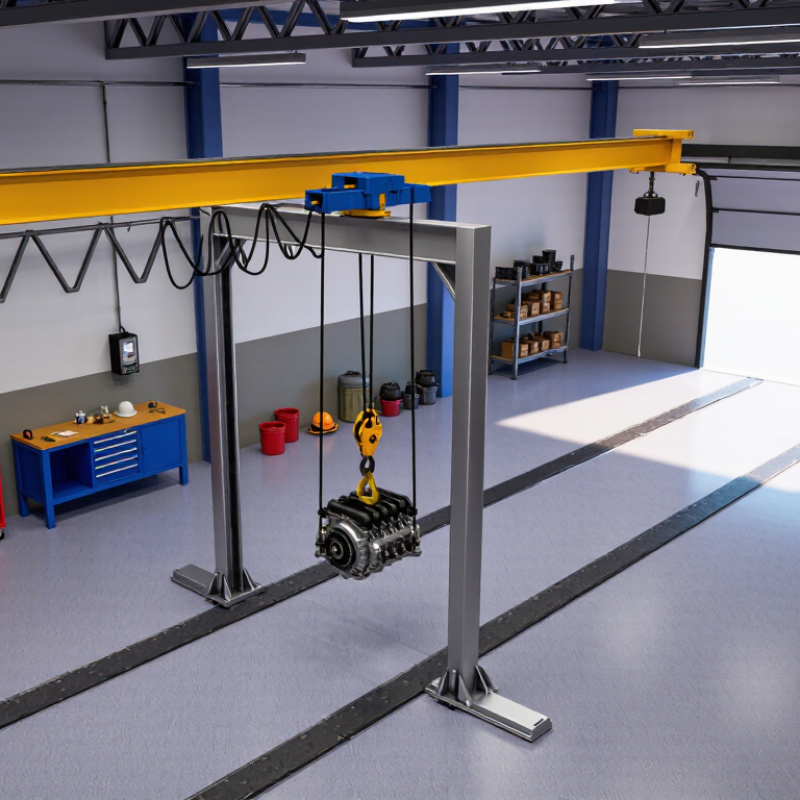
A garage overhead crane is a lifting system mounted above a workshop floor.
It moves heavy engines, steel frames, or machinery along a runway, rather than across the ground. Most systems include a bridge, end trucks, hoist, trolley, and pendant or remote control. The bridge travels lengthwise, while the trolley moves sideways. The hoist raises loads vertically. This arrangement keeps floor space open and reduces awkward manual handling. It is more than a ceiling-mounted winch. The supporting structure must carry dynamic loads safely.
In a typical garage, the crane may attach to reinforced beams or independent columns. Existing ceiling joists are not automatically suitable. That is a common mistake. A qualified engineer should verify load paths, clearances, runway alignment, and anchoring before installation. Capacity should match the heaviest planned load, including lifting accessories. A two-ton load can create greater forces during starting, stopping, or swinging. Real work is rarely perfectly smooth. I would also measure door height, vehicle clearance, and available power before choosing equipment.
When selecting a garage overhead crane, consider span, lift height, duty cycle, control method, and inspection access.
A compact crane may suit occasional repairs, but frequent production work needs stronger duty specifications. Do not rely only on advertised capacity. Check the technical manual, installation requirements, emergency stopping method, and maintenance schedule. Operators need training and must keep people outside the suspended-load area. Even experienced users can misjudge headroom. Record inspections, label controls clearly, and stop using the crane when unusual noise or drift appears.
Which Load Capacity and Lifting Height Should You Choose?
Choosing a garage overhead crane starts with the real load, not the advertised maximum. Record the heaviest item, lifting accessories, and any liquid movement. Then add a sensible safety margin without treating it as extra capacity. OSHA 1910.179 requires the crane’s rated load to be clearly marked and never exceeded. ASME B30.2-2022 also emphasizes inspection, operating controls, and safe load handling.
For example, a 1,000-kilogram machine may need a 1,250-kilogram crane after including slings, hooks, spreader beams, and handling forces. That figure is an engineering starting point, not a universal rule. CMAA Specification No. 70 classifies crane service by duty cycle, which matters in busy repair garages. A crane lifting twice daily needs a different design review than one moving engines every hour. Bigger is not always better.
Lifting height requires careful measurement. Measure from the finished floor to the highest obstacle, then subtract the trolley depth, hoist body, hook assembly, sling length, and the load’s own height. A 4-meter ceiling may provide only 2.8 meters of usable hook height. Leave clearance around lights, doors, sprinklers, and ventilation equipment. This is where many estimates fail. I would verify the lowest hook position with a real load mock-up, because drawings often ignore bent slings and uneven floors. Recheck the calculation with a qualified engineer before installation.
How to Choose a Garage Overhead Crane? - Which Load Capacity and Lifting Height Should You Choose?
1. Recommended Load Capacity by Typical Garage Application
Use the maximum expected load, not the average load, when selecting crane capacity.
| Garage Application |
Typical Load Range |
Recommended Rated Capacity |
Typical Examples |
Selection Guidance |
| Light maintenance and hobby work |
100–500 kg |
0.5–1 tonne |
Motors, gearboxes, pumps, small machinery parts |
Choose at least 25% more capacity than the heaviest planned load. |
| Automotive repair garage |
500–1,500 kg |
1–2 tonnes |
Vehicle components, engines, transmissions, axles |
Consider the weight of lifting beams, slings, hooks and other below-the-hook equipment. |
| Small fabrication or machine shop |
1,000–3,000 kg |
2–3 tonnes |
Machine tools, steel assemblies, welding fixtures |
Check whether the supporting building structure can safely carry the wheel loads and impact effects. |
| Heavy-duty private workshop |
3,000–5,000 kg |
5 tonnes |
Large machinery, fabricated frames, industrial equipment |
Obtain a structural review and confirm runway, end-truck and foundation requirements before purchase. |
2. Load Capacity Selection Checklist
Important factors that affect the required crane capacity.
| Factor |
What to Check |
How It Affects Selection |
| Maximum lifted load |
Identify the heaviest object that may be lifted during normal work. |
The crane rated capacity must be equal to or greater than the total suspended load. |
| Rigging and lifting accessories |
Include slings, shackles, lifting beams, spreader bars, magnets or grabs. |
Accessory weight reduces the remaining capacity available for the load. |
| Load distribution |
Check whether the load is centered, balanced and evenly supported. |
An off-center load can increase wheel loads and create dangerous side forces. |
| Duty cycle |
Estimate lifting frequency, operating hours and average load percentage. |
Frequent lifting or repeated heavy loads may require a higher duty classification and stronger components. |
| Future requirements |
Consider equipment or workpieces that may be added later. |
A moderate capacity margin can prevent early replacement, but oversizing unnecessarily increases cost and structural demand. |
| Building support |
Verify roof beams, columns, runway beams, foundations and connection details. |
The building must be designed or verified for vertical loads, horizontal forces and dynamic effects from crane operation. |
3. Recommended Lifting Height by Garage Ceiling Height
Approximate lifting-height guidance for common garage configurations.
| Garage Clear Ceiling Height |
Recommended Hook Travel |
Practical Lifting Area |
Typical Use |
Important Clearance Considerations |
| 3.0–3.5 m |
2.0–2.5 m |
Low-rise work area |
Engines, small machines and palletized components |
Allow clearance below the roof, crane girders, hoist body, hook block and the highest load. |
| 3.5–4.5 m |
2.5–3.5 m |
General workshop area |
Vehicle assemblies and medium-sized machinery |
Confirm that the hook can reach the floor or loading platform without the hoist reaching its upper limit. |
| 4.5–6.0 m |
3.5–5.0 m |
Medium-height lifting area |
Fabricated structures, machine tools and taller equipment |
Check interference with lighting, ventilation ducts, sprinkler systems and garage doors. |
| Above 6.0 m |
5.0 m or more |
High-bay workshop area |
Large machinery and multi-level handling operations |
Review hoist motor rating, rope or chain length, sway control and emergency lowering arrangements. |
4. Lifting Height Calculation
Required Hook Travel = Highest Required Load Position − Lowest Required Load Position + Operating Clearance
Example calculation for a garage with a 4.2 m clear ceiling.
| Calculation Item |
Example Value |
Explanation |
| Clear ceiling height |
4.2 m |
Distance from the finished floor to the lowest permanent obstruction. |
| Crane and hoist headroom |
0.6 m |
Space occupied by the crane girder, trolley and hoist assembly. |
| Required upper hook position |
3.6 m |
Approximate maximum hook elevation after allowing for headroom. |
| Required lower hook position |
0.2 m above floor |
Allows the hook and rigging to approach a low load without contacting the floor. |
| Approximate usable hook travel |
3.4 m |
Actual selection must be confirmed against the specific hoist dimensions and required safety clearances. |
5. Capacity and Lifting Height Matching Guide
Practical combinations for common garage overhead crane projects.
| Maximum Total Suspended Load |
Suggested Crane Capacity |
Suggested Hook Travel |
Suitable Garage Type |
| Up to 500 kg |
0.5–1 tonne |
2–3 m |
Private garage, hobby workshop or light maintenance area |
| 500–1,500 kg |
1–2 tonnes |
2.5–4 m |
Automotive service garage or small repair workshop |
| 1,500–3,000 kg |
2–3 tonnes |
3–5 m |
Fabrication shop or machinery maintenance area |
| 3,000–5,000 kg |
5 tonnes |
4–6 m |
Heavy-duty workshop with verified structural support |
Safety note: The values in this guide are preliminary planning ranges, not a substitute for a site-specific engineering assessment. Final crane capacity, lifting height, duty classification, runway design and safety devices should be selected in accordance with applicable local regulations and the manufacturer's technical documentation. Never exceed the rated capacity, and never lift people with a material-handling overhead crane.
How Should Garage Space and Crane Dimensions Be Matched?
How to Choose a Garage Overhead Crane?
Matching garage space with crane dimensions requires more than measuring wall-to-wall width. Measure the usable span between structural supports, not the total room width. Leave clearance for end trucks, runway beams, doors, lights, and stored equipment. A crane that fits on paper may still restrict vehicle movement or block a service door.
Check the required lifting height carefully. The hook must reach the load without striking the roof, lighting, or garage door tracks. Compare the crane’s overall height with the lowest overhead obstruction. Also measure the lifting path from the floor to the roof structure. A compact crane may provide less hook travel than expected. Confirm the supporting structure with a qualified structural engineer before installation. Garage ceilings are not automatically designed for suspended loads.
Tips: Measure twice. Still verify. Record span, headroom, hook height, and floor clearance. Mark the crane’s travel path with tape before purchasing. Test whether a person can safely stand outside the moving load area. Consider future storage changes, not only today’s layout. I once saw a careful measurement fail because a ventilation duct was ignored. Small details matter. Select capacity from the heaviest planned load, including lifting accessories. Keep operating controls accessible, and maintain clear walkways around the entire travel route.
Which Crane Design and Power Options Fit Your Work?
Choosing a garage overhead crane starts with the work, not the catalog. Your design should match load paths, headroom, travel distance, and duty cycle. For repeated engine lifting, a top-running bridge crane usually provides cleaner floor access and wider coverage. An under-running crane may suit a low roof, but its runway limits require careful measurement. Measure twice. Include hook approach at both walls; a high capacity rating means little if the hook cannot reach the service bay. CMAA Specification No. 70 and ASME B30.2 both emphasize rated capacity, inspection, and operating conditions.
Power selection also affects operating cost and control. Electric hoists suit most enclosed garages because they provide steady lifting and precise pendant or remote operation. Three-phase power generally supports frequent lifting and longer travel better than single-phase service. Where compressed air already exists, pneumatic hoists can be useful, although compressor noise and energy losses deserve attention. The U.S. Department of Energy’s Industrial Motor Systems Market Assessment reported that motor systems consumed about 68% of U.S. industrial electricity use. Efficient motors and variable-frequency drives therefore deserve serious consideration.
Do not oversize blindly. A larger hoist can increase purchase cost, structural demand, and standby energy use. Yet selecting the smallest unit may create unsafe overloads and rapid wear. A practical specification should record the heaviest load, lifting frequency, average lift height, and available electrical service. It should also include an engineer’s runway and support review. My imperfect rule is simple: design for real work, then challenge every assumption before installation.
How to Choose a Garage Overhead Crane?
Typical rated-capacity ranges by crane design
Workstation cranes are commonly selected for light assembly and maintenance tasks, while jib cranes suit localized lifting around a fixed column or wall. Single-girder overhead cranes provide a practical solution for many garages and workshops, whereas double-girder cranes are generally chosen for heavier loads and higher-duty operation.
For power selection, 230 V single-phase systems are typically suitable for lighter-duty equipment where available. Industrial hoists commonly use 400–415 V three-phase power because it supports higher motor output and smoother operation. Always confirm the required lifting capacity, duty cycle, available electrical supply, headroom, span, and building structure before final selection.
What Safety Features and Maintenance Needs Should You Consider?
Choosing a garage overhead crane starts with the work, not the maximum lifting number.
Measure the heaviest load, lifting height, runway span, and available headroom. Select a rated capacity above normal loads, but do not treat extra capacity as permission to overload. A competent engineer should verify the building structure, runway supports, and electrical supply before installation. This step is often rushed.
Safety features deserve close attention.
Use upper and lower limit switches, overload protection, emergency stop controls, and reliable mechanical brakes. Guards should cover moving parts, while a pendant or remote control should respond without delay. Warning alarms and clear load markings help people keep out of the lifting area. Follow applicable safety standards and site procedures.
During a site inspection, check hooks for cracks, latches for proper closure, and wire ropes for broken strands or crushing.
Inspect chains for elongation and abnormal wear. Look at runway bolts, end stops, wheels, and welds. A small change in travel noise can reveal a developing problem. Do not ignore it.
Maintenance should follow the crane maker’s schedule and the actual duty cycle.
Heavy daily use needs more frequent checks than occasional lifting. Lubricate approved points, test brakes and limits, and keep electrical enclosures dry and clean. Record every inspection, defect, repair, and replaced component. Operators need training in load balance, sling selection, hand signals, and emergency procedures.
No checklist is perfect. Our maintenance habits can become careless when the crane seems dependable.